
Canine Corneal Ulcer Surgery
Corneal ulcers in dogs are among the most common eye conditions we treat at View Referrals. Whether your dog has a superficial ulcer or a deep corneal ulcer, early treatment is essential. As veterinary ophthalmologists with decades of experience in veterinary medicine, we provide tailored canine corneal ulcer treatment across Central Scotland.
Canine Corneal Anatomy and How Corneal Ulcers Develop
The cornea is composed of 3 layers – a outer layer called the epithelium, a chunky middle layer called the stroma (this provides most of the corneal strength) and a thin inner layer called the endothelium. When the epithelium is damaged, we call this an ulcer. This can be shallow, just affecting the outer epithelium, or can be deeper, exposing the underlying stroma to infection and further injury, and triggering pain as nerves also become exposed. A corneal ulcer can occur following trauma, a foreign body, ectopic cilia, or dry eye caused by decreased tear production.
Conditions We Treat
Superficial ulcers
Superficial ulcers affect only the epithelium, and most corneal ulcers at this depth heal quickly and well.
Indolent ulcers
Indolent ulcers (also known as indolent corneal ulcers) involve loose epithelium that fails to reattach, causing slow healing.
Stromal ulcers
Stromal ulcers extend into the corneal stroma and often need more aggressive treatment.
Deep ulcers
Deep ulcers reaching Descemet's membrane risk corneal perforation.
Melting ulcers
Melting ulcers involve rapid corneal degeneration/liquefaction and can see a shallow ulcer progress to a deep ulcer in a matter of hours to days, often triggering other painful secondary complications inside the eye.
How a Corneal Ulcer Is Diagnosed
We apply a fluorescein stain to highlight the ulcerated cornea and assess how deep the ulcer appears. A Schirmer tear test measures tear production, and we check for corneal oedema, corneal vascularisation, and blood vessels growing into the corneal surface. These findings shape every treatment plan. We also hunt closely to see if we can identify the initial cause of the ulcer.
How We Treat Your Dog's Corneal Ulcer
Treatment depends on the type and severity of your dog’s corneal ulcer.
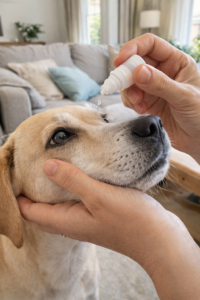
- Superficial ulcers usually heal with medicated eye drops, including antibiotics, along with pain relief and lubrication to keep your dog comfortable. Most dogs need eye medication several times a day until the ulcer has fully healed.
- Indolent (slow-healing) ulcers may need a simple procedure, such as diamond burr debridement or a superficial keratectomy, to remove loose tissue and encourage healthy healing.
- Deep ulcers or those at risk of perforation may require surgery. Procedures such as a corneal graft help protect the eye, promote healing, and give your dog the best chance of preserving their vision.
Worried About Your Dog's Eye Health?
If your dog’s eye appears sore, cloudy, or partially closed, ask your vet to refer you to View Referrals. Early referral helps ensure your dog’s ulcer is managed properly from the start.
For urgent enquiries, please contact View Referrals on 07344 407 630.
Our services include
Cataract Extraction Surgery
Corneal Grafting & Reconstruction
We perform intricate procedures to treat deep corneal ulcers, perforations and other corneal pathology, using techniques such as corneo-conjunctival transposition grafts.
Corrective Eyelid Surgery
Expertise in resolving painful conditions like entropion (in-turning lids), ectropion, and the removal of eyelid tumours or ectopic cilia.
Glaucoma Management
Cherry Eye Surgery
Surgical repositioning of the prolapsed gland of the third eyelid to maintain tear production and eye health.
Comprehensive Ophthalmic Assessments
Detailed examinations using slit-lamp biomicroscopy, tonometry (pressure testing), and chromatic Pupillary light tests to assess retinal function.
Many more things
If you pet has an eye problem, then we will be here to help.